Getting creative to spread our narrative
It’s time to create our final communications content and narrative interventions! Having come up with the essence of our narrative ideas to meet our goals in chapter 6, we tested those out in chapter 7, and now it’s time to put what we’ve learnt into practice. In this chapter, we’ll transform all the raw materials we’ve come up with into solid content: exploring formats like video, graphics and creative action.
It’s possible at this point that you’re wondering: “how do I actually fit all the best practice you’ve covered into the comms that I actually do day-to-day?” Great question! The main thing here is to just give it a good go. It’s very rare that you’ll have the opportunity to create a single piece of content or action idea that does all of the things you want or need it to do. However, we encourage you to get producing, and to spread the key components of your narrative out through different outputs.
Here’s an example from We Make The Future demonstrating ways of using elements of the tried-and-tested ‘Race Class Narrative’ over time, breaking it down into different formats:
So, let’s get creating!
Start your creative brief
Before making any kind of communications content or narrative intervention, it helps to make a short creative brief. This is a tool that summarises:
- Your campaign focus.
- Who your audience is.
- What you want them to think, feel and do.
- How you plan to reach them—which media platforms, cultural spaces, or types of communication will be most effective.
- The key messages and narrative content that you’ve been working on up to now—including learnings from any testing carried out so far.
- Any creative/ design inspiration you already have that you’d like to influence the final output.
Ideally this tool will help ensure you and your teammates are really agreed and not just making different assumptions which come back to bite you later. And it will be really useful if you are getting someone with specific design skills to help—share this to help get on the same page easily.
Here’s a great simple example from PIRC friend and associate, Sho Walker-Konno:
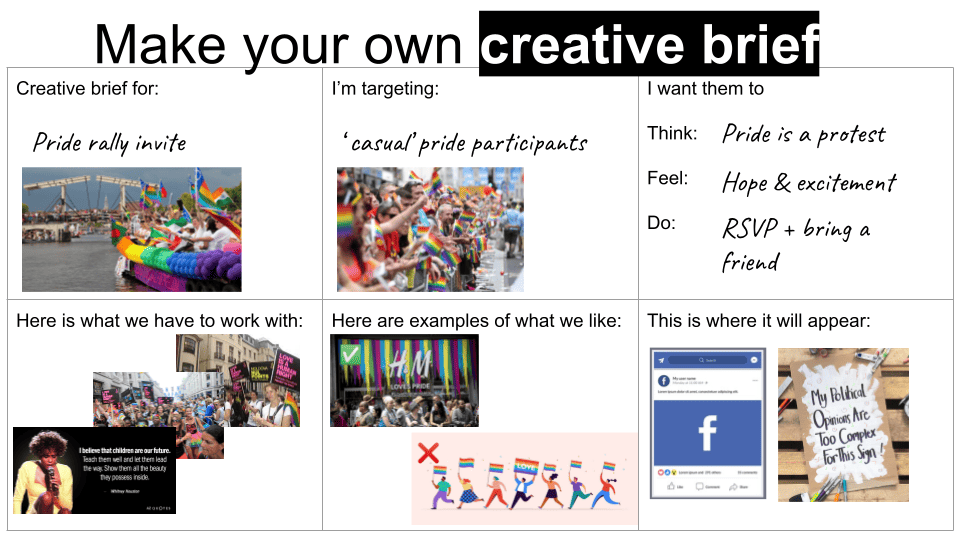
So let’s kick-off your creative brief by answering the following:
What are you hoping to create communications content or a narrative intervention for? Who are you targeting? And what do you want them to think, feel and do?
Choose your platform
So, we’ve covered those foundational questions, now it’s time to work out which media platforms and cultural or social spaces make most sense for you to reach your audience through. This is not just about the largest platforms (mainstream media and social media) but also who they trust. Are they influenced by the people they know? Or by something they see everyday on the street or at work?
It can help to pause here and think about where the dominant narratives that influence our audiences are being spread—those might make sense to be our battlegrounds to try and push back with our progressive narratives. Alternatively, we might choose to bypass those battleground spaces in favour of more intimate ways to connect—through local community initiatives, their union representatives, or their favourite podcast. The choices we make here will look different for all of us, depending on our narrative goals.
Here’s an overview of some key platforms available to us for reaching our intended audiences, as campaigners. For each area, we’ve included some signposts to more information and learning, and offered some practical examples of narrative initiatives that are geared towards these platforms:
- Traditional media/press
e.g. broadcast interviews for TV news, letters to newspaper editors, writing opinion pieces.
Spokesperson and Press Officer handbooks from NEON
How to respond to the culture wars, from Align & NEON - Social media & digital campaigning
e.g. targeting corporations on Twitter/X, mobilising young people on TikTok, organising a demo via Whatsapp, shifting beliefs through podcasting.
How to generate 100 social media concepts in 1 hour.
Online training and support for digital campaigning from Social Movement Technologies —including these free access offerings. - Pop culture interventions
e.g. script-writing for stage or screen, influencing producers of TV programmes, writing features for magazines, targeting the gaming industry.
Transforming the storyline of a major TV soap, with All About Trans.
Culture-defining initiatives lead by racialised groups, like POCC, MAIA, and interventions for migrant justice by PopChange. - On the doorstep
e.g. door-knocking (or ‘canvassing’) ahead of elections, hosting community meetings, persuading your nan.
Using ‘deep canvassing’ methods to support change through 121 conversations—on the doorstep, on the sofa or by the coffee machine. - In the streets
e.g. organising demonstrations that tell a powerful story, designing media stunts, setting up industrial action with your union.
The Beautiful Trouble toolbox for strategies and tactics that have inspired people-powered victories and upended the status quo.
Which platform does it make most sense for you to use, thinking about your audience and goals?
We haven’t covered everything in the overview above, so please include any different ideas you have here that feel strategic for you and your audience.
Choose your format
Thinking about your core messaging, and the audience you want to reach: What format will be most effective? If you’re looking to tell a story that demonstrates change, a video might help you to bring a sequence of events to life. Or perhaps you want to get something shared and reported quickly, in which case an unedited photo might be better.
Where will your audience most likely be reached? Does that suggest a specific format will be more useful? Maybe you’re hoping to persuade inner-city parents, in which case you might want to organise a door-knocking initiative or a local community meeting.
We cover some key formats below—click on the drop-down buttons to explore these in more depth. It’s not an exhaustive list, but hopefully you’ll find some inspiration here. Let us know if you’d like us to add any other formats to the list in the future, and we’ll do our best!
Graphics and Visuals
e.g. posters, infographics, banners, content for social media.
Why this format?
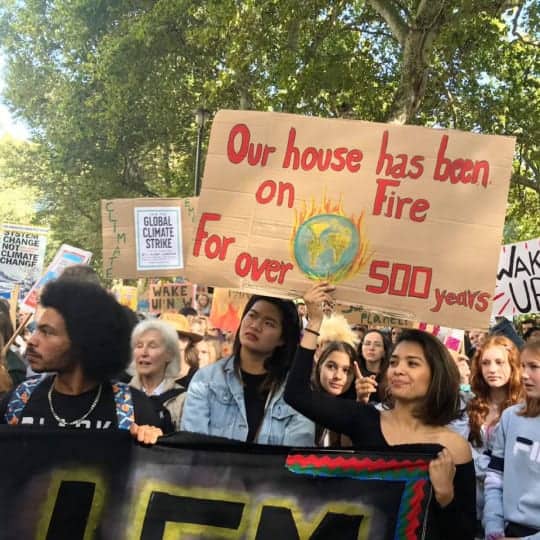
Good visuals make people feel first, and think second, and have the potential for wide reach (e.g. through meme-culture). They can bring abstract ideas to life, and easily bring principles, communities and experiences into the frame using symbols (e.g. the rainbow pride flag, or a fist raised in solidarity).
Top Tips
- Pick up some graphic design basics, and brush-up your photography skills.
- Search beautiful free image databases at: here, here and here.
- Make use of free software like Canva and Adobe Spark.
Video
e.g. Rapid response videos for social media, fuller campaign videos, instruction videos, etc.
Why this format?
Effective videos evoke powerful emotions. Emotions drive decisions. Effectively pairing words with pictures and video enhances attention, memory, recall, and believability.
Top tips
- Make simple videos with what you have on hand!
- Consider how your messenger, location and action can amplify your message.
Check out tutorials from the folks at VideoRev for step-by-step guides on making your own videos, including 30+ ‘hook’ ideas (and here for a walk-through of the whole process).
Podcasting
Why this format?
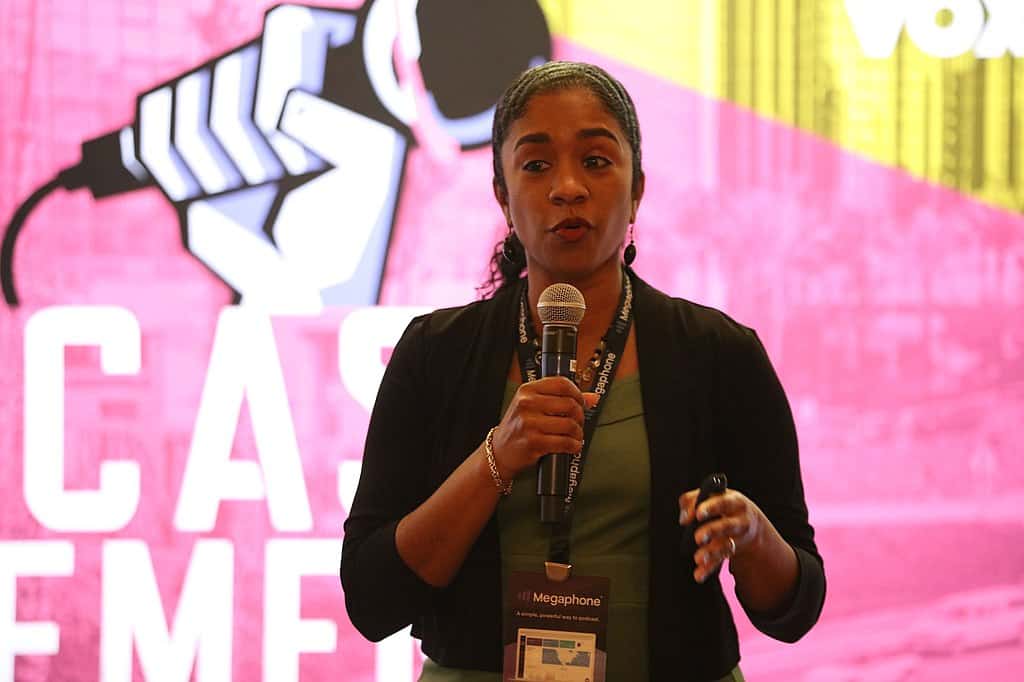
Podcasts are simple to create, intimate and impactful.
Top tips
- Make it regular, we humans generally thrive on routine!
- Imagine you’re talking to a friend – keep it natural and conversational.
- Start shorter (10 mins) and go longer (40+ mins) as you build your experience.
- Use free audio editing software, like Audacity.
For more, sign-up for free to SOGI’s Podcast e-learning course.
Cultural campaign stunts and direct action
Why this format?
Creative action and cultural campaigns carry the deep power of ‘show-don’t-tell’. They have the potential to engage your audience’s hearts and minds, and move us to action in ways that other formats scratch the surface of.
Top tips
- Action logic is key!
- Know your rights when taking direct action.
- Find creative inspiration from the Beautiful Trouble and Empowering Nonviolence anthologies.
Check out the video above, exploring the impact of ‘Little Amal’, a 3.5m tall puppet representing a 9 year old girl who was a refugee moving from country-to-country on her way to the UK. We found Sho Walker-Konno’s interview with Michael Braithwaite really helpful in thinking about whether a cultural intervention is effectively changing the narrative or not.
Advocacy Emails
Why this format?
Emails provide space for us to unpack our full narratives, and provide signposts and opportunities for action. It’s also possible to build-up deeper connection with people over time, if we get our email strategy right.
Top tips
- Get to the point in the very first sentence.
- Only ask people to do one thing.
- Make it personal.
- Is it clear for the reader: Why this? Why me? Why now?
- Use the post-script.
For more, check out this guide from More Onion on crafting a good email. Social Movement Technologies provide in-depth training for folks who want to nail their email strategies for the long-term.
Press interviews
Why this format?
This has the potential to reach a lot of ‘on the fence’ and persuadable people. It can be emotionally-intensive, and has the potential for high impact—depending on your audience.
Top tips
- Get to know the show you are pitching to.
- Have your key talking points ready, and use ‘bridging’ (ABC method) to stay on-message.
- Setup your support network for post-interview care and debriefing.
Hassan Akkad’s interview on Good Morning Britain (see the video above) is a great example of delivering key points, bridging and dealing with challenging questions.
For in-depth guidance, check out NEON’s excellent Spokesperson and Press Officer handbooks, and get in touch with them for support, training and opportunities to connect-up with progressive spokespeople and press officers.
Door-knocking
Why this format?
This is both time – and emotionally – intensive, but has the potential to create deeper lasting change, whilst building the relationships we need at the community level to organise for big progressive wins.
Top tips
- Talk to persuadable people, move on from strong opinions.
- Listen and ask questions.
- Share your story and highlight common humanity.
We recommend using a storytelling format called ‘Public Narrative’—pioneered by Marshall Ganz in the US during the Obama presidential campaign, and now widely used in campaign canvassing. (Visit this page for video examples of the method in action.)
Check out this short video series from Resistance School that covers the key components of values-based persuasive conversations on the doorstep—known as ‘deep canvassing’. And dig into this article for a deeper dive—including a real example of door-knocking that built support for protective legislation for Trans people.
Let’s give it a go…
It’s time to finish your creative brief!
We’ve set up a template for you to duplicate or download and have a go at filling in your full creative brief, ideally with your group (but it’s okay to do this solo too). Take another look at Sho’s example above for inspiration, and let us know if you need any support?
If you’d like to, please send a copy of your brief or a prototype of your narrative intervention to us by email or on Twitter/X. We’d love to see what you’re creating.
Let’s get reflective…
We reckon there may be enough learning links and creative inspiration to reflect on in this chapter, so we’ll leave it there!
In the next chapter, we’ll plan the path ahead for implementing your communications content or narrative intervention, and we’ll explore (meaningful) ways to monitor your impact. Meanwhile, if you’ve got any questions or feedback you’d like to share, feel free to drop us an email on courses@publicinterest.org.uk