Creating our narrative ideas
It’s time to get creative!
We’re switching gears now: having covered lots of big-picture strategic thinking about our audience and our goals, we’re moving into the practical and creative work of framing our narrative ideas.
In this chapter, we begin developing our narrative ideas and tools: designing content (messaging ideas, imagery, metaphors) that is aimed at meeting the narrative change goals that we set ourselves in the last chapter.
Jargon busting time!
Before we jump in, a quick refresher on what we mean by ‘frames’:
- The folks at the Narrative Initiative give a helpful explanation: “Frames articulate our worldviews, which are in turn activated by language: cues in communication that generate unconscious, intuitive and emotional responses. Think, for example, about environmental ‘regulations.’ Now think about environmental ‘protections.’ These two frames can evoke strikingly different reactions to the same set of governmental agencies and practices.”
- Framing is a strategic process that starts with an acknowledgement of the power of story and narrative to create change. The work of ‘framing’ is about how we communicate: the process of shaping our communications in order to tell, or emphasise, a particular belief or set of beliefs. It involves understanding how people already think and feel about our issues and making intentional choices about what to focus on.
- Framing draws on different frame elements—such as values, metaphors and examples—to perform different functions within the wider framing process.
We are framing every time we communicate, whether intentionally or not.
Eyes on the prize
We’ve included lots of creative prompt activities below to help you develop lots of different framing components for your narrative project.
As you make your way through these, keep your audience (chapter #4) and your narrative goal (chapter #5) in mind throughout this creative process. This will help you stay focused on the key work that your frames need to do to build support for your narrative.

Framing 101: top tips
“Narratives shape the way in which problems and priorities are identified; they limit the types of solutions that are viewed as acceptable and possible, and determine how certain types of people are categorized and treated….”—Brett Davidson
Can you think of any communications that really didn’t work, and why? What lessons can you take away from these examples about effective communications practice?
Over the years, we’ve picked up a fair bit of experience with what can be helpful and unhelpful when communicating our narrative ideas. So before you get stuck in to the creative work, here’s a few tips to help you design effective frames:
- Speak to people’s better selves: one of the worst things we can do as communicators is condescend and disrespect the people we talk to. Even people who we don’t often agree with share many of our motivations and values, and want to do the best they can.
- Create common ground: find ways of expressing your shared identity and building an expansive ‘us’, and people will be much more supportive.
- Talk about change: people need to see that a problem can be solved, and that they have a role to play in the change, in order to be motivated to act.
- Make it real: our decisions are often primarily based on our prior understanding, our beliefs, how we feel, what we value, and how the facts are packaged. Avoid relying on the facts alone, and instead tell stories and use powerful images to evoke emotions—such as hope, anger, joy and love)—which have the power to activate our deepest values.
- Don’t think of an elephant: Assert your own framing proactively, and avoid myth-busting and responding to attacks. If we do the latter, we risk reinforcing the beliefs we’re trying to counteract.
For lots more tips and good-practice framing guidance, check out the learning links below. We’d love to hear if you have picked-up any other good practices on your journey?
Let’s give it a go…
Okay! Below, we invite you to explore five key frame elements, which you can use to build the narrative toolkit for your campaign:
- The ‘Translated Story’
- Visual & Action ideas
- Messengers
- Metaphors
- Examples
We appreciate this might feel like a lot, so if you’ve only got a bit of time now try picking one or two activities and have a go. Then come back to other activities later with friends, allies, teammates and co-conspirators
1. Translate ‘Our Story’ into a shared story
The essence of your issue—the values & vision, problem and solutions woven together—written with your audience and narrative goal in mind.
E.G.
“Whether we are Black, white or brown, most of us want to make life better for the generations to come. But certain politicians, their super-rich friends and the media they own are endangering our future to benefit themselves. They are fuelling damage to our climate, selling off our NHS and slashing funding for our youth centres and schools. Then they spread lies about ethnic minorities, Muslims and people seeking asylum to distract us from how their decisions harm us all. In the past, we joined together to create the NHS, and today, we can work together across our differences to demand secure green jobs, good education, and a better future for all of us, our children and our grandchildren.”—NEON Messaging Handbook
Have a go at translating ‘Our Story’ (Chapter 3) into a story that your audience will be more able to connect with and take onboard, drawing on your audience research (Chapter 4). To do this, we recommend using The Opportunity Agenda’s VPSA structure (see page 20-21):
- Values & Vision (reminding people of shared values deepens our common ground)
- Problem
- Solution
- Action (and/or Outcome)
What emotional response do you think this is likely to prompt in your audience, and how helpful will that be for your narrative objective?
Once you’ve got your translated story sketched out, why not have a go at writing it as a…
- Message in your family WhatsApp group
- News headline
- Tweet
2. Play with visual and action ideas
Pictures, photos and graphics that can convey your meaning without needing to use words.
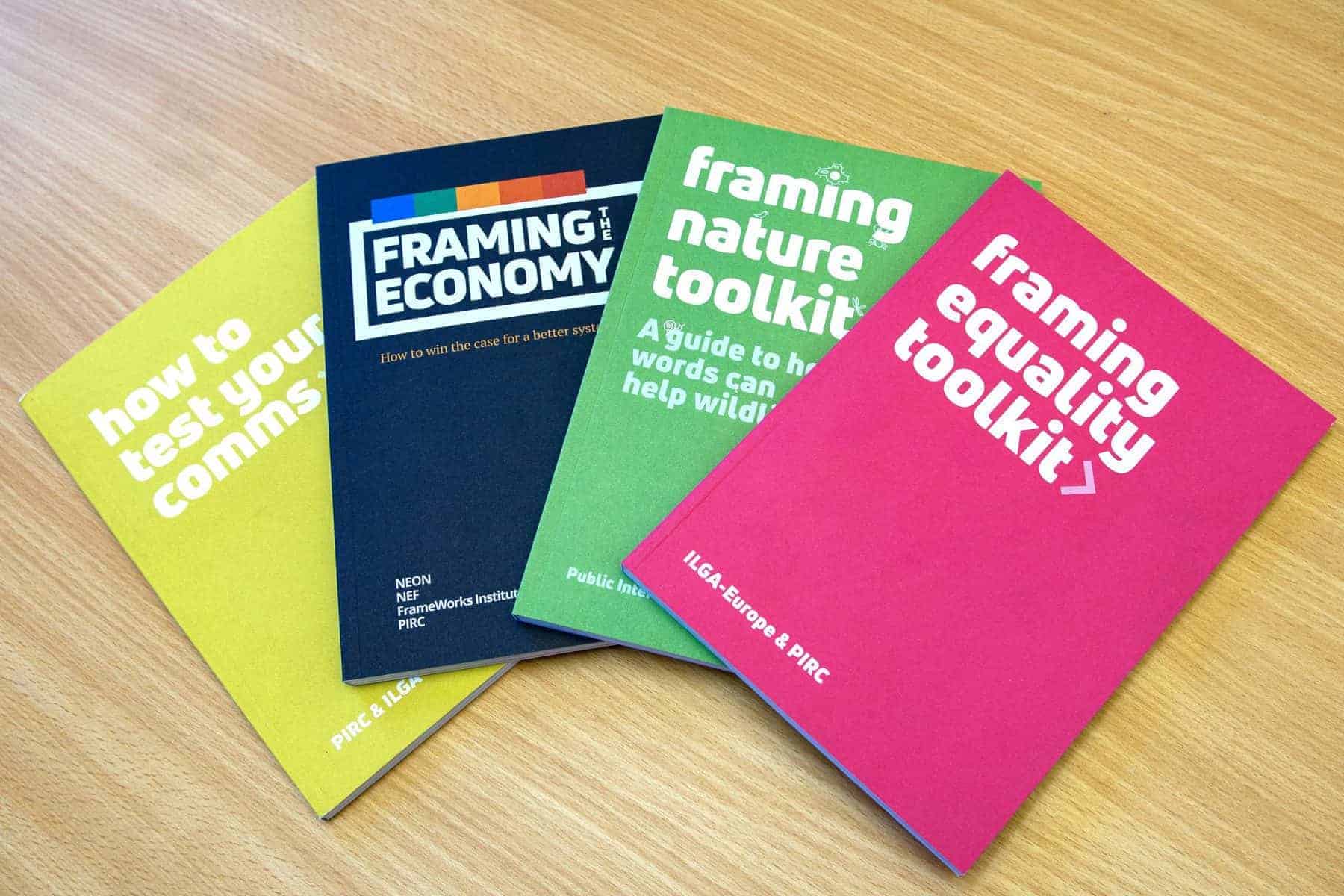
In our Framing Nature Toolkit, we explore the use of imagery in conservation framing, asking questions like: What does your image say about who nature is for and what people should do when they are outdoors? And we explore how to balance the problem with solutions, aiming to stimulate hope for change. Take a look at p34-45 for more.
What does the problem look like, in the translated story? What does the vision look like? And the solutions that get us there? Who are the characters?
Grab some colouring pens, or old magazines/scissors/glue, or get searching online, and play with possible visuals that you might use to help convey your framing ideas to your audience.
Dig around for inspiration:
- Google image search (switch on the creative commons search tool to find images that are free to use).
- Gif library search
- Look at some examples of campaign posters or book/film/album covers that made you feel something strongly
Actions speak louder than words!
Can you think of creative action ideas that could bring your narrative ideas to life. Consider how these action ideas might make sense politically to an outside observer within your audience.
For more action inspiration, check out the Centre for Story-based Strategy and their Picture This! card decks: www.storybasedstrategy.org/card-decks.
3. Consider your messengers
The person, group (or other living beings) that could most effectively communicate the message, helping people understand it and be supportive of the outcomes.
E.G.
In 2015, Ireland voted for Marriage Equality for LGBT people. Research showed that the most effective messengers for winning over the moveable middle were predominantly straight parents, grandparents, and other members of the community who saw the referendum as an opportunity to promote fairness. So they focussed on showing LGBT people embedded in their families and communities, to great effect: The messengers were as important as the message; videos of grandparents talking about why they were voting Yes went viral.
Who do you and your audience both trust to tell the translated story, to share your key messages? What is their connection to your issue(s)?
4. Mess around with metaphors
Using a relatable everyday concept to convey something more complex, and help people reason about ‘xxxx’ in a more helpful way. We often use metaphors in communication to help people understand the problem.
EG
This metaphor conveys that the economy is a made by human design and can be redesigned:
“The economy is a program that is constantly being revised and updated. Over the last forty years, large corporations and banks have gained the password to the economy and gained the ability to revise policy and reprogram the economy so that it runs how they want it to. As a result, the economy has been programmed for corporate interests but has become harder for most people to use. We need to reset the password so that we can reprogram the economy and rewrite the policies that make it run so that it works for everyone.”
Can you identify any concepts in / aspects of your translated story (above) that would really benefit from being broken down, with the help of a metaphor?
If your issue was…
… a film, what film would it be?
… an animal?
… a game?
… a recipe?
What other ideas would help to break down the complexity of the issue you’re working on?
5. Identify helpful examples
Referencing cultural and historical events and stories can help you to overcome a faultline.
E.G.
The UK smoking ban is an example of a quick change in social norms, and legislation. Before the ban, the tobacco industry’s vested interests held us back from much-needed changes.
In Reddi Eddo Lodge’s book, ‘Why I’m no longer talking to white people about race’, she tracks a fictional black youth’s prospects from school to employment to explain systemic racism.
Is there a story or experience you can think of that connects well with your issue? A historic movement, campaign or policy that changed things on a similar issue?
Responding to attacks
Sometimes, we do have to respond to our ‘elephants’—the direct attacks, fake news, harmful myths and messages, and interference run by our opposition. So let’s think about when it’s worth responding, and what to say when you do.
What are some of the most common attacks and harmful or unhelpful messages that you hear? Who says them, and where? Which media sources or platforms?
Do you need to respond?
Which of these people and platforms/media would your audience hear from the most, and find most persuasive? It’s very rarely worth our energies to directly counter our opposition—the more effort we can put into building power for our progressive narratives, the better. But if there are any challenges that feel especially powerful for your audience, consider if and how to engage. The rest, we ignore.
- Will it significantly impact your audience?
- Do you have the capacity?
- Are you directly impacted by this attack, and if so, can you give yourself space to pass this on to allies or team-mates with more distance or resource to take on the emotional impact?
- Are you in a position of privilege where your response might support those more marginalised?
We recommend having a go at responding to these attacks with friends, allies or team-mates. Try this ABC method (yep, another one!):
- Acknowledge the question or opinion (“example”)
- Bridge from the question/opinion to your talking points (“I think the important thing to think about here is…”)
- Communicate you message ([insert ideas from the activities below!])
Beware of myth-busting and responding to fake news by directly refuting it: saying “x isn’t true” simply reinforces the original false belief in people’s minds. Instead, have a go at a ‘Truth Sandwich’ from George Lackoff, or take a leaf out of Anat Shenker Osorio’s book: ‘Refute the liar, don’t repeat the lie’. Check out the learning links below for more.
Let’s get reflective…
Learning links…
If you’ve got 15 minutes:
- Read (3.5ish mins): Don’t Parrot—from Framing Matters: A short guide to avoiding common communication pitfalls.
- Watch (15ish mins): Fast Frames: Video Series—from FrameWorks Institute: Bite-size learnings from the researchers at FrameWorks, exploring solutions framing, use of data, visuals and more.
If you’re keen for more:
- Read (25 mins): The Narratives We Need—from PIRC: Our most comprehensive look at the common narrative struggles that our movements face across progressive issues, identifying 5 narratives that hold potential for deep lasting change.
- Read (3.5 mins) and/or listen (25 mins): George Lakoff’s Truth Sandwich + Interview—from Future Hindsight: A practical tool for tackling lies and misinformation from the social scientist behind ‘Don’t Think of An Elephant’.
Got lots of time? Great:
- Long-read: The Messaging Handbook—from NEON: Top tips and practical examples (including words that work) from our friends over at NEON.
- Read (15ish mins): Finding the right messenger for your message—from SSIR: Exploring eight archetypes and four audience contexts to help organisers find the right trusted messengers.
In the next chapter, we’ll explore the basics of how to test our communications—to see if they’re doing what we want them to be doing! Meanwhile, if you’ve got any questions or feedback you’d like to share, feel free to drop us an email on courses@publicinterest.org.uk.