Building our own movement stories
Often, within our movements, we come together hoping to be on the same page, only to run into conflict further down the line. The reality of movement organising can often feel like we’re pulling each other in opposite directions.
Taking the time to unpack what we care about—exploring the problem in depth, our motivation for working on it, the solutions that we believe are needed, and the vision that we’re working towards—lays a vital foundation for our narrative and communications work to build on.
We do this right at the start of any new framing or narrative creation process, to give us a clear compass to use when we’re navigating the sea of wider beliefs and stories on our issues (which we’ll explore next week). For us, this is about unlearning all the dominant narratives that we’ve been told about ‘how the world works’, ‘what other people are like’, ‘whether change is possible’—the stories that have been designed to maintain the status quo, pit us against one another, drain our belief in people power. Instead, we root ourselves in our own stories: in our values, visions and analysis.
Here’s a beautiful example of a movement story of the Green New Deal told by Alexandra Ocasio Cortez, an activist in the US who became the youngest woman to ever serve in Congress:
From ‘A Message From the Future’ – The Intercept, illustrated by Molly Crabapple. The video is around 7 minutes.
Before we dive in…
In this chapter, you’ll notice that we’re inviting you to reflect on a few questions to build your story, which you have the option of sharing with us via the boxes below. Your responses will be anonymous, and will contribute to our long-term efforts to map the ideas, hopes, dreams and needs of campaigners and organisers that we support. If you would like to keep a copy of your responses for yourself, we recommend copying and pasting them into a separate resource for safe keeping!
A few pointers for the focus of this chapter:
- Defining ‘our movement stories’ is not intended to produce the public story (i.e. the narrative/messaging/slogans) of your campaign at this stage—we’ll get to that in good time!
- We encourage you to work through this chapter in community, with co-conspirators and allies working on connected issues. Narrative change can only happen when we build power with one another across our movements, and find alignment in our values and shared narratives of the world and the change that we want to see.
- When we talk about alignment, we’re talking about the challenging and productive work of overcoming the division and isolation that we’ve learnt from dominant culture, finding genuine common ground and getting comfortable in our differences. For us, the goal is to support groups in our movements to find forward motion together, accepting that there will be different tactics, approaches, and aspects of our stories. Maybe you’ve heard of the phrase ‘singing from the same hymn book’—we’re not all singing the same song, but there is harmony nonetheless (Narrative Initiative call it ‘polyvocality’). The folks at FrameWorks show this with a handy visual:


1. Grounding in our values
“Values are the principles or standards that we each carry through our lives and that guide and inform our thoughts, attitudes and actions. They influence, and are influenced by, our experience of the society in which we each live. Our values help determine what is important to us and shape how we interact with other people and the more-than-human world.”—Common Cause Foundation
Let’s begin with our values. We start here, because our values form the heart of our social change efforts—they give us motivation, drive our sense of purpose, and are deeply connected to our emotional selves. (And as we know, humans are not primarily rational creatures.) Our values influence many aspects of our lives, such as our choice of friends, our lifestyles, our political engagement, and our personal wellbeing. They also influence how we act on social and climate justice issues.
Taking a values-based approach helps us develop resilience in our organising and activism: By charting a course that points towards our values, we’re also choosing to act for deep, long-term culture change, rather than feeling tied to the rollercoaster of short-term wins and losses. We’re supporting ourselves to do this work together for the long-haul.
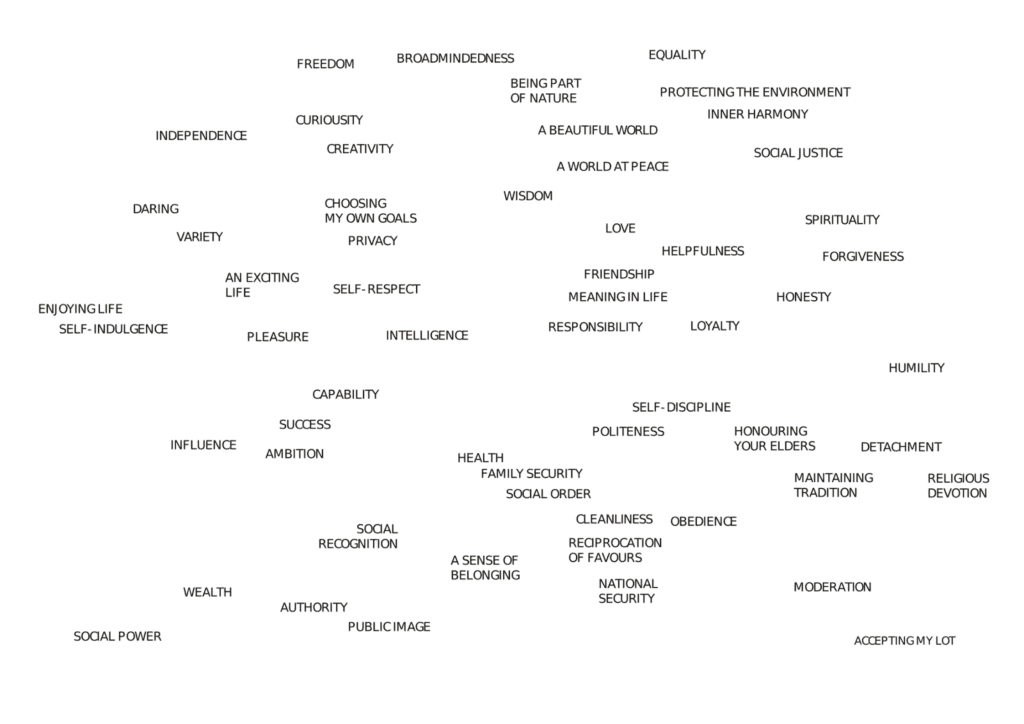
Download the Values Map as pdf.
2. Dreaming-up our vision
“We are living in the imaginaries of those long gone before us, one day people will be living in the imaginaries we’ve created”—Angela Davis
To find alignment and build our shared narrative, we need to be clear about what we’re fighting for, as well as what we’re against.
Often, as progressives, we get stuck in the mode of identifying what’s wrong and what isn’t working in the world. This critique—which we’ll get to further down—is a strong basis for the work that we do, but often it ends there and we don’t go beyond that.

Afrofuturists teach us of the power and need for visioning work in our movements, for folks impacted by systemic oppression: the need to write ourselves back in, and root our visions in the struggles that we have lived—and are living—through.
Vision inspires, it helps us be clear on what we want to achieve in the future, it paints a picture of what the future will look and feel like. Visions are anchoring and give us a sense of purpose. Visioning is hard – it asks us to let go of all of the barriers and obstacles we see as limiting our ability to be successful and actually believe in the future we are working everyday to create.
“To change the story, we must exercise political imagination and stretch the terms of what is deemed ‘politically realistic’ in the present moment. Imagination builds power because it opens the space for crafting stories that make just futures possible. Liberation requires vision. And vision, without imagination, leads us down the path already set for us… By imagining justice and just futures we expand our capacity to create them.”—Centre for Story-based Strategy
3. Defining our analysis
“Nations and peoples are largely the stories they feed themselves. If they tell themselves stories that are lies, they will suffer the future consequences of those lies. If they tell themselves stories that face their own truths, they will free their histories for future flowerings.”—Ben Okri

Finally, let’s get clear on our analysis—or ‘strategic assessment’—of what the problems are, how they came about, and what’s needed to overcome them to build a better world.
As we mentioned above, this may feel like more familiar territory for us as community organisers and campaigners.
Again, we encourage you to do this with others if possible: Building broader consensus on our collective movement analysis is vital if we’re going to transform the status quo and opposition stories over time.
“We are living in the imaginaries of those long gone before us, one day people will be living in the imaginaries we’ve created”—Angela Davis
Let’s get reflective…
Reflective questions
- How does your own positionality (your various social identities, such as gender, race, class, ethnicity, age, geography) shape your understanding of the issues you’re working on, and where can you see that in your responses to the questions above?
- Narrative change is a collective effort, and there is power in setting a vision. So, who is involved, and who is missing? Who could you revisit the questions in this chapter with, that goes beyond your usual suspects?
Learning Links
If you’ve got <15 minutes:
- Read (2 mins): Our Story of Climate Justice—from the Framing Climate Justice project (PIRC, 350.org and NEON): A one-page example of a movement-centred story of climate justice.
- Read (5 mins): Hate Racism, Love Finland—from PIRC: An introduction to values theory, focussed on the connection between values and prejudice. References identity-based discrimination.
If you’re keen for more:
- Read & watch (15 mins): ‘How long ‘til black future month’—from PIRC: Our top ten Black inspirations for framing & narrative for the future. Contains references to racial violence and systemic oppression.
- Listen (1 hour): adrienne maree brown on Future Visioning, Layered Time and Grief—podcast episode from All That We Are: Exploring ideas on how we can come to imagine and embody a future in which we are free.
Got lots of time? Great:
- Long-read: Common Cause Handbook—from PIRC: Our practical, in-depth introduction to the importance of values and frames for groups working towards a more sustainable and just society. For more, dive into more resources from the folks at the Common Cause Foundation.
- Long-read: Experiments in imagining otherwise—by Lola Olufemi: Beautiful book navigating “the space between what is and what could be. Weaving together fragmentary reflections in prose and poetry, this is an exploration of the possibility of living differently”.
Now that we’re clearer on what ‘our story’ is made of, in the next chapter, we’ll zoom out to situate our story within the wider context of societal beliefs, values and existing narratives on our issues. Meanwhile, if you’ve got any questions or feedback you’d like to share, feel free to drop us an email on courses@publicinterest.org.uk.