Mapping the narrative landscape
“Caring for myself is not self-indulgence, it is self-preservation, and that is an act of political warfare.”—Audre Lorde
In this chapter we’re going to dive into the wider narrative landscape surrounding the issues that we’re fighting for. These issues are often very close to our hearts, and taking action on them nurtures our joy, creativity and sense of connection. Many of us have also experienced pain, rejection, the discomfort of being surrounded by moulds we don’t fit, violence. And our truths are constantly undermined by the lies of others.
We’re going to be unpacking some of the wider, damaging, dominant beliefs that exist about our issues in this chapter. Feeling grief, anger and the desire to lash out is a wholly legitimate response. We encourage you to take space to feel and process any pain and anger that comes up for you, and to draw on your support systems wherever you need to.
“They just don’t get it!”
Narrative change work is about understanding how our words, actions, campaigns interact with people’s thinking, and then using that understanding to craft our efforts to shift common sense and create sustainable social change.
However, when we’re in reactive mode, it can be hard to step back and take in the wider narrative landscape: the contradictory values, emotions, beliefs, ideas, worldviews, narratives, stories and memories that people hold in relation to our issues. Often, something bad happens, we get together with folks we know who care about it, we create demands, organise an action or put a communication piece together and share it with the world… Only to find that people “just don’t get it”.
A FrameWorks Institute example of this is Jamie Oliver’s anti-sugar campaign about the dangers of sugar in children’s food and drink. It was a public information campaign, targeting the corporate food industry for irresponsible behaviour, and outlining all the negative effects of sugar on childhood obesity and other health outcomes. The campaigners thought if they could effectively communicate the health problems of sugar then it would build public support for government regulation of corporates. Cue lots of tweets with images of piles of sugar and rotting teeth.

What the campaign failed to realise was that their audience had a strong pre-existing belief that was disrupting their framing, a ‘blocking belief’ as it were: The belief that parents are responsible for the health of their children. The campaign wasn’t working because people thought “well, it’s parents, not corporates, who should be looking after children and making sure they don’t get too much sugar in their foods”.
We like to think of ourselves and others as fact-processing machines, but we’re more like conclusion-jumping machines, driven by our emotions and lived experiences. And that’s a good thing! Conclusion-jumping is what enables us to walk into a room we’ve never been in before and immediately identify what’s going on. We can tell when we’re in danger, we can feel empathy for others. But when it comes to narrative work, if we ignore human beings’ conclusion-jumping abilities, we’ll get into trouble.
So let’s work out who it is that you’re aiming to bring with you on your campaign or project journey, and get to know more about what will be shaping their conclusion-jumping in relation to your story of your issue(s).
Choosing where to put our energy…
“Don’t take the temperature, change it…”—Anat Shenker Osorio
Who we aim our communications and campaigning at is a big strategic question. We want to talk to people who we can reach in some way and whose minds we may be able to shift: to be more supportive of the issues we’re working on or more active in their engagement with our issues.
To help with this, we find it useful to distinguish between a number of different groups:
- Your base: People who are already (broadly) supportive of your issue: activists, campaigners, supportive parliamentarians.
- Your moveable middle: People who can be persuaded. These may be people who are undecided or haven’t engaged with your issue.
- Your target: People (or institutions) whose behaviour you want to shift, by leveraging your base or moveable middle.
- Your opponents: People who are strongly opposed to your issue. They are unlikely to ever be supportive of your message.
How people think about our issues…
“There is an objective reality out there, but we view it through the spectacles of our beliefs, attitudes and values.”—David G. Myers
Now that we’ve got clearer on who you’re hoping to bring with you, it’s important to understand the competing and conflicting beliefs they hold about our issue and related issues: how they think and feel, what they value, how they think change happens and who’s responsible for it, how they understand right and wrong.
The task is to get to know the people we’re aiming to bring with us well enough to see where there’s connection—or ‘enabling’ beliefs—between our different understandings, and where there’s potential for movement and change in their ‘blocking’ beliefs.
In building this understanding, keep in mind:
- People are complex, and we’re all capable of holding multiple conflicting beliefs within ourselves at any given time;
- People have the capacity to shift and change their current thinking. Can you think of a time where you had your heart and mind changed on something? If so, keep that memory with you, as you continue through this chapter.
The question of how your audience thinks is one that you can find the answer to in a number of ways—from analysing existing framing of issues, to building new relationships, and carrying out research to learn more.
A. Framing is an indicator of how people think
Often, where the folks in the middle are at reflects what the dominant narratives of our time emphasise. And we know these narratives are unacceptable. They have deeply influenced how people understand issues, and what values they are driven by.
Looking at how communications are framed allows us to consider:
- How the audience are encouraged to think; and
- What the cultural impacts may be.
For example, although there are very few words in the poster below, it is rich in meaning and suggested direction. This is a campaign poster from the UK Independence Party in 2016, promoting leaving the European Union. It draws heavily on a number of common frames:
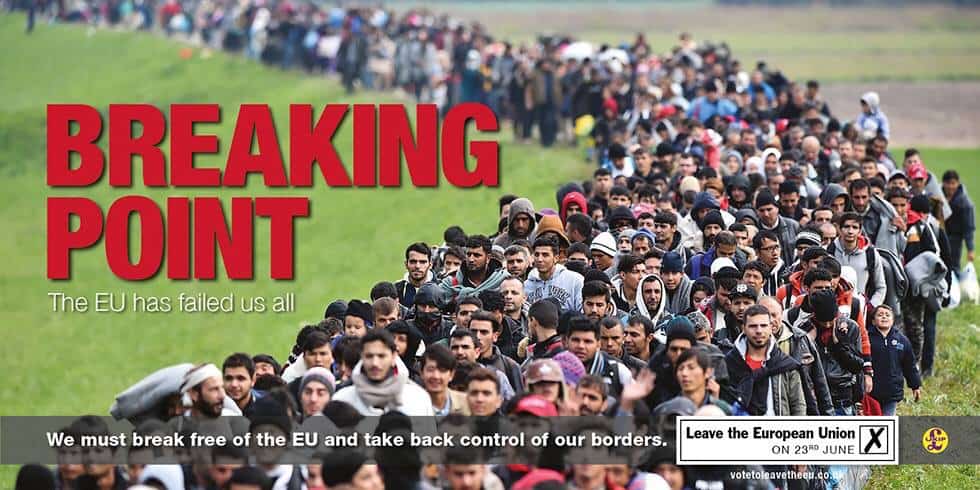
We see an apparently infinite visual stream of refugees (that brings to mind dehumanising & racist metaphors such as swarm), emphasising that Britain is full. It looks a bit like an invasion: and there’s no indication of what these people might do when they arrive. A bleak future is predicted with the term breaking point: unless we act to break free. The EU is a villain: the oppressor; the UK its failed victim. It’s designed to evoke fear in a moveable audience; a sense that immigrants are different; and it evokes values of national security. Ultimately, it was part of the mass framing project in 2016 that led to a massive spike in hate crimes against immigrants, the murder of a pro-EU parliamentarian, and the UK population voting to leave the European Union.
*If you want to dig deeper on this, pick a few examples of print or online media that you think are representative of common understanding, then carry out a framing analysis with your co-conspirators. See p16-21 of PIRC’s Framing Equality Toolkit for tips on how to do this (see learning links below).
B. Complexifying the map
Analysing existing communication gives us some idea of where the moveable middle might be on our issue(s). But it’s likely to be an incomplete picture. So the next step is to dig deeper, and complexify the map of our narrative landscape.
Understandably—given the status quo—campaigners and progressive communicators often tend to assume the worst about people: that they don’t have any understanding or sympathy for the ideas that underpin ‘our story’ of our issues. So here’s some things we’ve learnt at PIRC that might help you to deepen your understanding:
- People are emotional. We often mistakenly believe that we need to communicate to our audience through rational and coherent arguments alone. However, as well as (sometimes!) considering the evidence, our decisions are often primarily based on our prior understanding, our beliefs, how we feel, what we value, and how the facts are packaged.
- People share our values. It’s easy to imagine that if people don’t accept the equality of our communities, they must have fundamentally different values. The temptation is therefore to appeal to a set of values that we don’t subscribe to ourselves, when communicating with others. But as we touched on last week, a large body of research shows that everybody shares the same set of values—a set that ranges from benevolent care for others through to concern for personal success—though we differ in how much we are driven by different sides of the values map.
- People think in stories and models. We use many shortcuts to reason about the world: including through creating and recognising patterns. These patterns are like stories—or mental models—that provide the architecture through which we understand issues. We hold many of these stories in our minds. Some of them are conflicting (such as the English idioms, look before you leap and the early bird catches the worm). Some of them are shared (there are similar idioms to both of those that are shared by many other languages). Importantly, some stories are more helpful than others in advocating for progressive causes (think of all the different stories of the origins of poverty—laziness, divine necessity, politically created).
- People’s sense of their power and agency has been attacked. It’s easy to imagine that showing people a problem should be enough to motivate a response. But our sense of our individual and collective power has been systematically eroded for a long time. People need to see that a problem can be solved, and that they have a role to play in the change, in order to be motivated to act.
- People are clever, reasonable and nice. It’s easy to caricature the public as stupid and easily-led, particularly when an election or referendum doesn’t go our way. But one of the worst things we can do as communicators is condescend and disrespect the people we talk to (think of the post-Brexit fall-out). Rather, we should remember the times when we have ourselves had to change our minds. We should aim to respect the journey our audience may have to go on—acknowledging their discomfort, without reinforcing it.
C. Ways to find out more
What else do you want to know?
Here’s some ways you can keep building the map of your audience’s narrative landscape:
- Pool your common knowledge: Get together with other campaigners, organisers and allies and pool your common knowledge of what people think about your issue.
- Chat to your aunt/neighbour/fitness instructor: We all have folks in our lives who sit somewhere in the moveable middle. Invite them for a cuppa, and have a chat to learn more about how they see the world and your issues. Try to stay curious and focussed on listening, rather than reacting or responding at this stage.
- Simple discourse analysis: If you’re feeling resilient, spend time (with a buddy?) looking at the comments sections of online media around your issue. Amongst the strong opinions on either side, you’ll find the views of the moveable middle.
- Desk research on zero budget: As a place to start, take some time to explore the research findings from existing projects, such as Framing Climate Justice, Reframing Race, PIRC’s guides on Framing Equality, the Economy and the Pandemic, or issue guides from our collaboration with NEON. And you can do your own research: Search for academic papers via Google Scholar; stats from market research agencies such as YouGov or IpsosMORI; or international datasets like Eurobarometer, the European Social Survey or the World Values Survey. Remember that these sources don’t always show you where people have the capacity to go to or change from here.
“We are human, not data points.”—said everyone, always
Let’s give it a go…
Hopefully, we’ve now got a better idea of who we’re aiming to bring with us and a sense of the beliefs and narratives that are likely to be shaping their understanding of progressive issue(s). So, let’s have a go at writing ‘their story’ of the issue(s) we care about: outlining the building blocks of their values, vision, and understanding of the problem and solutions. (A bit like we did last week for ourselves, but this time putting ourselves in our audience’s shoes.)
Let’s get reflective…
Learning links
Content note: Most of these resources reference both helpful and harmful beliefs and ways of thinking about issues that we care about.
If you’ve got 15 minutes:
- Read (15ish mins): The Narratives We Need—from PIRC: having reflected on all of our learning over the years, we summarised commonly held public beliefs in five key areas: what people are like, who is in our sphere of concern, who is responsible for the problems we face, how the system works, whether (and how) change happens. (Jump to our Wakanda version to learn about these beliefs through the tale of the Black Panther).
If you’re keen for more:
- Read & Do: Framing Equality Toolkit: ‘Know Your Audience’, p32-47—from PIRC: Practical look at common mental models and ways of thinking. Skim read if you’re short on time, or get a cuppa and get stuck in! (check out Framing Climate Justice and our other guides for more mental models and ways of thinking on these issues).
- Watch (2.5 mins): British Social Attitudes 2023—from NatCen: summarising attitude changes over the last 40 years, on things like sexual and family issues, social class, the role of government, taxation and spending. There’s wins and losses here, so give yourself space to process the feels.
Got lots of time? Great:
- Read (10 mins): To segment or not to segment—from PIRC: a practical blog on when and how to use ‘audience segmentation’ in your campaigning.
- Read (5 mins): What’s the difference between framing research and opinion polling—from FrameWorks: Does what it says on the tin!
In the next chapter, we’ll compare our story of our issue (from last week) with what we know of our audience’s stories, and we’ll use that to decide what to focus our efforts on shifting. Meanwhile, if you’ve got any questions or feedback you’d like to share, feel free to drop us an email on courses@publicinterest.org.uk.