Setting our narrative goals
Narrative work, the shifting of consciousness and values, is not just a long game, it is the long game. It is not just about finding the right words to spread particular messages, but the ability to activate the underlying values and beliefs behind those messages. It’s about normalizing justice, inclusivity and equity.”—Narrative Initiative
As we explored in the last chapter, ‘moveable’ audiences have a number of competing narratives, values, beliefs and frames they use to think about issues of social, economic and climate justice.
We’re starting this week’s chapter by returning to your audience mapping work from last week, with one final step to land it—sorting your audience’s beliefs, values and frames into two key areas: The commonalities (enabling beliefs) and the differences (blocking beliefs) between your story of the issue(s) you care about (see week #3) and your audience’s story (week #4).
Here’s an example of the commonalities and the differences that we found with climate justice organisers during the Framing Climate Justice project:
So, over to you and your co-conspirators now! Thinking about the injustice that you’re fighting, circle round together to work out the common ground you share with your audience, and the key differences or ‘fault lines’.
Setting your narrative goal
“When your only goal is saving the whole world, you will always feel like a failure… Clear goals help us stay on track and increase our chances of creating change.” —Effective Activist
Having mapped out Our Story of the progressive issues we care about, learnt about Other Stories amongst our audiences, and looked at the common ground and fault lines between those, it’s time to work out: What’s the most important thing our narrative work needs to do?
We want our narrative work to encourage our audience to think differently, to achieve the outcome we are looking for. And we can’t take on every challenge in the narrative landscape: it’s important to focus our energies. To do this, we define our narrative goal(s), setting our sights on one or more key areas that we hope to shift with our work in future.
As a starting point, you and your co-conspirators might want to think about what you learnt from comparing the common ground and fault lines between your story and your audience’s stories, above, and consider whether you’re feeling motivated or well-placed to lean into either:
- the common ground, creating narrative tools that might help us to expand this.
- the fault lines, creating narrative tools that might help to bridge or challenge the differences in our beliefs and those of our audience.
Setting a narrative goal is as easy as ABC
AUDIENCE BELIEF OUTCOME
Let’s look at an example:
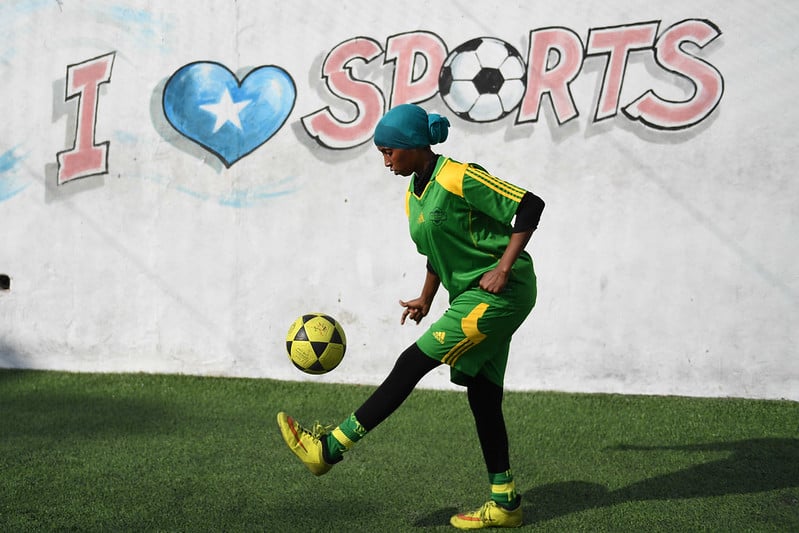
The Football Association (FA) has a vision of everyone of every age, gender, sexuality and race playing football all the time. One of their desired outcomes is that more girls play football at school. The audience they want to target are secondary school girls, plus their parents and teachers. They run some focus groups and do some research to find out that the main belief faultline is that people tend to think ‘football is for boys/men’ while the FA think ‘football is for everyone’.
So, the FA’s narrative goal might look something like:
- We want our communications to encourage school girls and their parents and teachers to believe that football is for everyone, in order for more girls to play football.
Before you have a go at creating your narrative goal, a gentle reminder of a key learning we touched on in the last chapter: Don’t underestimate where people are capable of moving to.
As Anat Shenker-Osorio says “conventional wisdom says to meet people where they are. But, on most issues, where they are is unacceptable”, and that’s largely because of the harmful dominant narratives that have been at the centre of cultural framing for a long time. But this isn’t the end-point. We all have the capacity to change, and most of us want the world to be kind, caring, just and sustainable.
So, centre your vision and values! Don’t sacrifice the long-term by compromising for a short-term ‘easy’ win (e.g. beware of dialling up beliefs that are tied to values of economic gain, social status or national security). Chances are, it’ll cause more harm than good if (see ‘No Cause Is An Island’ in the learning links below).
Sense-checking your narrative goal
Once you’ve had a go, give yourself some space—ideally with your group—to consider:
- Is this goal aligned with your vision and values, which you mapped out back in chapter #3?
- Is it concrete enough that you could make a plan for how to achieve it?
- Does this goal feel manageable for you and your collaborators? Think about your collective resources and capabilities.
- Can you set a timeframe for this goal? Maybe it’s a loose one, but it helps to have a window of time in which to focus your efforts.
- How will you know if you’re making good progress towards your goal, what will show you that you are on the right track?
“Focusing our energy on one (relatively) achievable campaign goal is an essential part of making bigger changes. It is one measurable step in the right direction, and enables us to build the skills, networks and empowerment to take on bigger goals in future.”—Seeds for Change
Let’s get reflective…
Reflective questions
- Consider what other folks in your movement are focussing their energies on—what narrative goals do you think other groups and organisations are working towards? Can you add strength to their efforts with your own, or can you fill a gap that needs to be filled?
- There is a lot of power in the goal-setting stage of any process. What does it look like for you to use your power responsibly, with care and intention, at this stage? Who are you listening to and taking inspiration from? Does your goal further the fight of folks most impacted by the injustice you’re focussed on?
Learning links
If you’ve got 15 minutes:
- Read/try-out (15ish mins): Rapid Response Worksheet—from Narrative Initiative: An alternative approach to setting your goal in a rapid-response situation, with an example of responding to migrant scape-goating.
If you’re keen for more:
- Read (3 mins): No Issue Is An Island—from Common Cause Foundation: an exploration of the interconnections of our struggles, and how communicating on one issue impacts many others.
- Read/try-out (15ish mins): Setting communications objectives—from The Health Foundation: Another alternative, slightly more in-depth approach to building a communications goal, with a focus on health.
Got lots of time? Great:
- Listen (32 mins): Words to win by: People Seeking Asylum—from ASO Communications: Another beaut of a podcast from their team and Shen Narayanasamy from GetUp. This episode focuses on the ongoing battle against the atrocities of offshore detention in Australia.
In the next chapter, it’s time to get creative! We’ll begin developing our narrative ideas and tools: designing content (messaging ideas, imagery, metaphors) aimed at our narrative change goals. Meanwhile, if you’ve got any questions or feedback you’d like to share, feel free to drop us an email on courses@publicinterest.org.uk