We are heartbroken to share that after more than 50 years as an organisation, and the last 15 years working on grassroots narrative change, PIRC will be closing in 2027.

Snapshot of our history
PIRC was founded in 1971 by Charles Medawar and Michael Young, and registered as a charity in 1973. It was originally conceived of as a British cousin of the Public Citizen network created in the US by Ralph Nader. Then Chair, Michael Young, founded several public interest organisations, among them The Consumers’ Association and The Open University.
PIRC’s early work was investigative, exposing harm done by corporations and excessive secrecy in British governance. Over the decades, PIRC followed the questions that mattered most. In the early 2000s, under the leadership of Tim Helweg-Larsen, we worked to radicalise the environmental debate in the UK, giving others the space to push for deeper change in policy and attitudes. We undertook a series of influential projects including: Climate Safety, Zero Carbon Britain, Carbon Omissions, Energy Bonds and The Offshore Valuation that served to inform civil society strategy, new campaigns, and political targets for renewable energy.
It was partly through witnessing the limits of the environmental movement, in particular its over-reliance on communicating information without an understanding of psychology, that we developed a crucial aspect of our approach — working on values in collaboration with Common Cause Foundation. In the 2010s, we produced a handbook on values and brought together a large network across many sectors of civil society. It also inspired a transition to a flat management structure. This experience — along with the learning, challenges and experimentation it has afforded — brought organisational development and culture into PIRC’s focus, and played a crucial part in our work over the last 15 years.
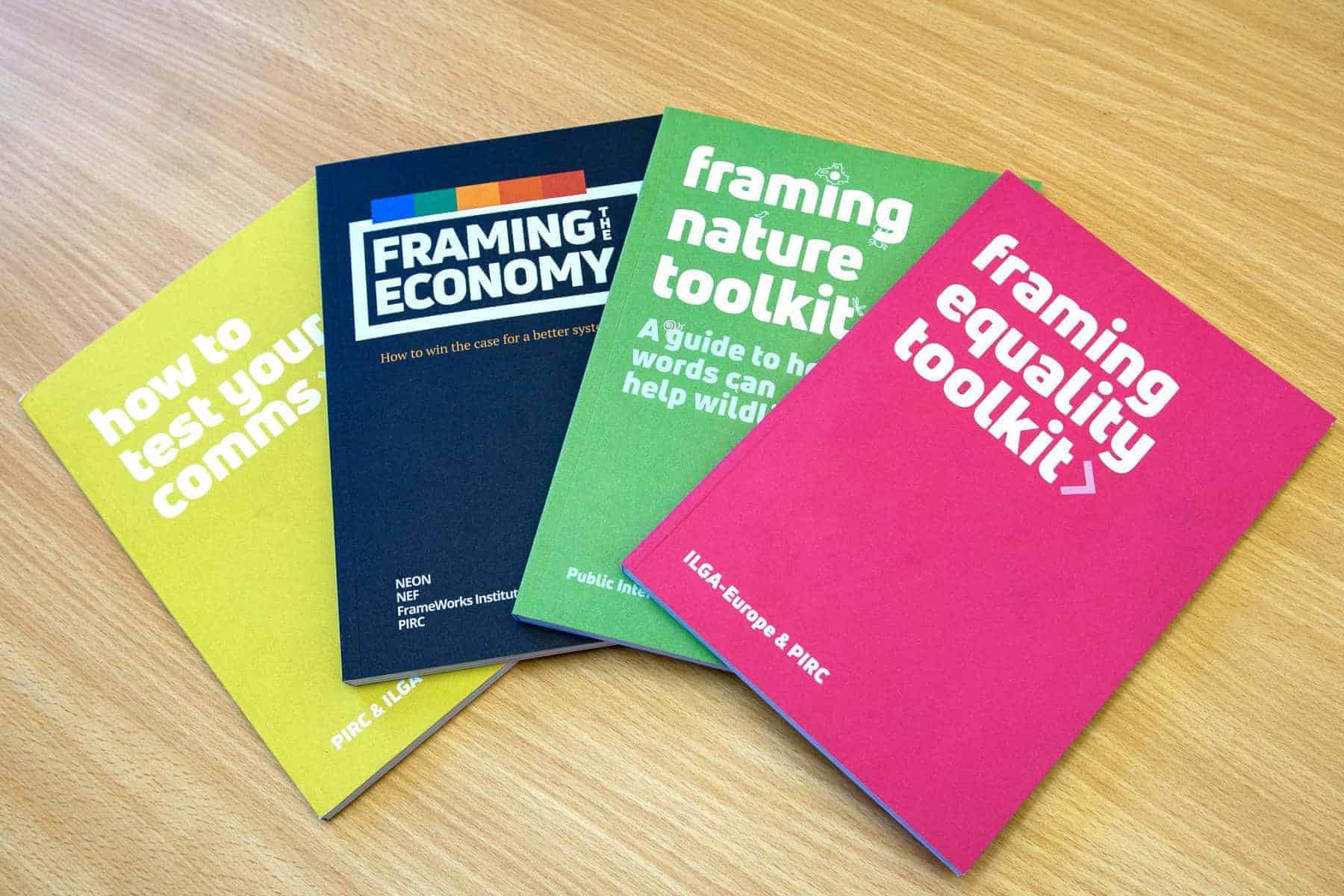
Our work on values led us to developing participatory approaches to framing through collaborative projects such as Framing Nature, Framing Equality, Framing the Economy, and Framing Climate Justice, which helped campaigners and activists understand how narratives shape our thinking and how shifting narratives can enable sustainable social change. We poured our learnings from these projects into The Narratives We Need — a deep exploration of the shared roots of the challenges we all face, offering steps towards what’s needed to address them through narrative work.
Since then, we’ve supported organisers and communicators to respond to the Covid-19 pandemic; collaborated on the Reframing Race project; supported the Gypsy and Traveller movement to fight back against media misrepresentation; accompanied frontline communities to get alternative solutions to policing into the mainstream; and worked with survivors to strengthen understandings of modern slavery. Most recently, we’ve challenged colonial practices in narrative work; created an introductory narrative change online course; and delivered the UK’s first narrative leadership programme for grassroots organisers with lived-experience of oppression: Building Our Narrative Power.
Why are we closing?
Our decision to close is part of a much bigger pattern of manufactured scarcity and infrastructure crumbling in this phase of late stage capitalism. Across the UK, the shared infrastructure of everyday life, from libraries and youth clubs to community spaces and local news has been hollowed out. All of this has been justified under dominant narratives of scarcity and inevitability. These narratives are unjust and inequitable, and have intensified with the support of the far right, mainstream media and political leaders.
The consequences are playing out in real time. We see them in devastating policies that further entrench injustices, and in media narratives that normalise scapegoating and demonising migrants, trans and Disabled people, and that justify the rise of authoritarianism and fascism. These narratives shape the material reality for people at the sharp end of oppression, and, at the largest scale, these patterns ripple through every aspect of society.
Civil society’s infrastructure is no different, and philanthropy, despite the best intentions of those within it, often ends up repeating patterns of wider systemic harms. In an economy predicated on the accumulation and maintenance of wealth, organisations like ours depend on persuading those who hold wealth to share it. Even when we’re successful, wealth distribution is within a non-profit industrial complex that seeks to maintain power and wealth where it has always been. Too often, funding is limited to short-term grant cycles built on narrow understandings of how change happens, and with little room or action to build long-term infrastructure and care.
PIRC has lived the cycle of financial precarity like many other small organisations for many years. Changing priorities and the shifts from cross-movement to issue-based funding has meant a mixed bag of expected and unexpected losses of support, alongside successes. The ongoing financial uncertainty, cycle of redundancy risk and long-term capacity strain have all taken a toll on us.
After much consideration of all possible options throughout 2026, our shared view as a staff team and Board, is that we don’t have what we need to carry on in the conditions we’d come to accept as ‘normal’. We have made a unanimous decision to close PIRC, prioritising dignity, operational responsibility and legacy for our movements.
Our closure is not unique — in recent months and years, many other infrastructure organisations and grassroots groups have made the same decision. Each closure is a symptom of a system that finds shorter-term funding easier than longer-term investment in community and movement infrastructure. Narratives of hate and division will continue to take centre stage, unless the alternatives get the support they need. We hope that this necessary and important work will be resourced in ways that gives us all a chance at longer-term structural change.
Our work
Over the next few months, we are prioritising work that offers support to grassroots narrative change practitioners, and ensuring that we archive our work so that it remains usable. Here’s a sense of what that will look like:
- An online Resource Library bringing together a mountain of resources from across our time as an organisation — from toolkits, reports, workshops, slides, worksheets and more. We are also exploring how we can keep this alive in the longer-term.
- Automated Introduction to Narrative Change online course.
- 1-2-1 narrative change clinics for grassroots narrative practitioners.
Thank you
Thank you to everyone who has been a part of PIRC over the years — whether you’ve participated in our programmes, attended our events and workshops, co-facilitated with us, offered your expertise as an associate or freelancer, worked with us as staff, or volunteered as trustees, pouring countless hours into supporting and guiding the organisation. Thank you also to those who have funded our work over the years and walked alongside us, including through this ending. Every one of you is part of PIRC’s story and your contribution will live on in our shared legacy.
With sadness, love and solidarity,
The PIRC team and Board
FAQs
When will PIRC close?
We don’t have an exact date yet as we’re in negotiation with our funders. Sign up to our newsletter for updates on this.
What will happen to PIRC’s resources?
We’re bringing more than a decade of toolkits, reports, workshop recordings, slides, worksheets and more into a free online resource library. Where possible, we will work to share our resources via libraries of peer organisations too. We’re currently working out how to keep it available in the longer-term too.
Can I still get support with my narrative change work?
Yes, we will be running 1-2-1 narrative change clinics for grassroots narrative practitioners over the next few months. Email hello@publicinterest.org.uk to book a 1-2-1 with a member of the team.
What alternatives did you consider?
We looked at every possible option we could throughout 2026 including targeted fundraising efforts, working to a skeleton model, transformation into a new entity, being housed in a different organisation and dormancy. Sadly the conditions that would enable PIRC to thrive don’t exist, and haven’t changed much for the last decade. Continuing means that a significant portion of our time would be spent keeping the organisation alive, rather than doing the work PIRC exists to do, or limiting our choices in a way that could force us into a decision to close abruptly, badly and painfully for the community.
Are your funders supportive?
Yes, our current funders have been supportive of both our work to date and in the work we will do until we close.
How can I stay in touch?
If you haven’t already, the best way you can find out more about what we get up to in the next few months is by signing up to our newsletter. You can also drop us a line on hello@publicinterest.org.uk. Please allow up to two weeks for responses as we have limited capacity until mid-November.