And that’s a wrap!
Ten chapters in, and we’re bringing ‘Getting Started with Narrative Change’ to a close!
Thank you for accompanying us on this learning journey, we hope you’ve found it useful.
In this final chapter, we’ll look back on the stepping stones of the course, share opportunities for furthering your learning, and provide space for you to share your feedback and reflections on the course. Then it is onwards dear friends, equipped with narrative tools for the road ahead.
“Neither revolution nor reformation can ultimately change a society, rather you must tell a new powerful tale, one so persuasive that it sweeps away the old myths and becomes the preferred story, one so inclusive that it gathers all the bits of our past and our present into a coherent whole, one that even shines some light into the future so that we can take the next step forward. If you want to change a society, then you have to tell an alternative story.” —Ivan Illich
Let’s take stock
We’ve covered a lot of ground in this introductory course, from from key terminology and concepts to tools and skills for strengthening your practice
Take some time to pause and reflect on the journey you’ve been on, clicking-back on any chapters that you haven’t had a chance to explore yet or ones you’d like to revisit:
- What is narrative change?
- Narrative organising in action
- Building our movement stories: Values, Vision & Analysis
- Mapping the narrative landscape
- Setting our narrative goals
- Creating narrative ideas
- Testing our narrative ideas
- Spreading our narratives
- Planning for impact
- … closing with: Taking stock & signposts to future learning
How has this journey been for you?
Were any of the chapters particularly useful in supporting your practice? Is there anything that you’re feeling a desire to dive deeper into? What did we miss that you’d like us to include in the next version of this course?
Jump down to the final section of this chapter for the link to the feedback and reflections form—we’d love to hear from you.
Continue your learning
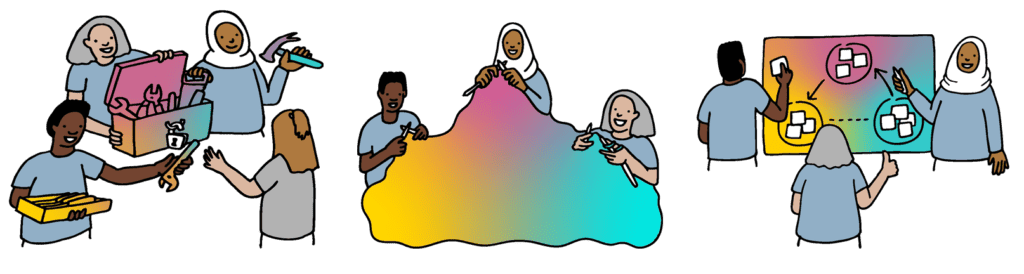
Looking to take the next step on your learning journey? Here’s a few signposts to get you started—they are all free learning links that you can access remotely:
Deeper-dive learning resources
- The Centre for Story-based Strategy have an abundance of inspiring and practical resources for continuing your learning journey, including worksheets, games and online workshops. We love their book ‘Re:imagining Change’ which you can download here for free.
- For framing issue guides and general good-practice recommendations, checkout these libraries from NEON, FrameWorks UK, Narrative Initiative, The Commons and ASO Communications (including Messaging This Moment).
- And lots more resources from us, via our mailing list and website: publicinterest.org.uk
Follow-on learning opportunities
- For regular narrative change meetups and webinars, sign-up for emails from Inter-Narratives, and check out their archive of recorded sessions exploring topics like disinformation and ‘the enemy’.
- Come along to Frameworks UK’s ‘Moving Mindsets’ webinar on 6th February 2024.
- If you’re into e-learning, the folks over at Sogi Campaigns have a series of short courses available for free (you just need to register), including: Campaign Communication, Storytelling, Narratives, Researching Attitudes, and more.
Further support
Can’t find what you’re looking for in the links above? Or maybe you’ve got a particularly gnarly challenge that you’re looking for support to work through?
Feel free to get in touch with us folks at PIRC—we’re a tiny team but we’re part of a big network of narrative and framing practitioners, so if we can’t help you then we might be able to signpost you to support elsewhere! Drop us an email on hello@publicinterest.org.uk or message us on Twitter / X with any questions or support needs you have.
“When we speak we are afraid our words will not be heard or welcomed. But when we are silent, we are still afraid. So it is better to speak.” —Audre Lorde
Let’s get reflective…
Reflective questions
This week is all about reflection! And for this final chapter, we’re reflecting on our learning journeys. So, we’ve put together a feedback form for you to share your experience of the course with us:
We’d love to learn from your experience so that we can develop this course for other folks in our movements in future. It’s the first time we’ve run something like this online, so please don’t be shy with what’s worked and what hasn’t worked from your perspective.
Learning links
We thought we’d leave you with one more link to some food for deep thought, focussed on the ‘how’ of narrative change:
- Read (6 mins): How can we decolonise narrative work?—from Elena Blackmore, for PIRC: A reflective and practical piece that invites us to explore “What might the work of learning and doing narrative change look like if we moved it beyond coloniality, capitalism, patriarchy and whiteness?”
That’s all folks!

This is the final chapter of ‘Getting Started with Narrative Change’. Thanks for coming on this journey with us! If you’ve got any questions or feedback you’d like to share, feel free to drop us an email on courses@publicinterest.org.uk