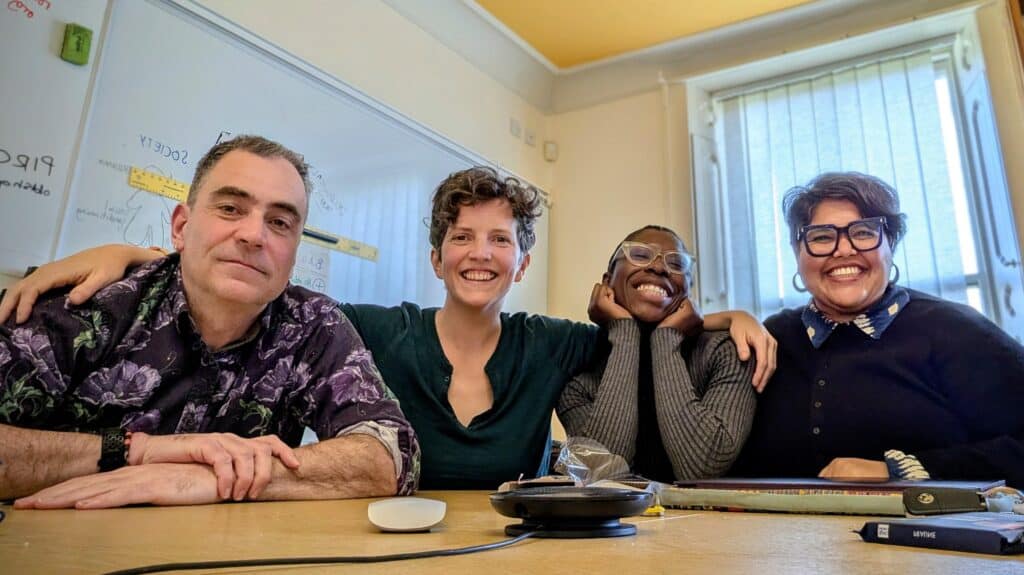
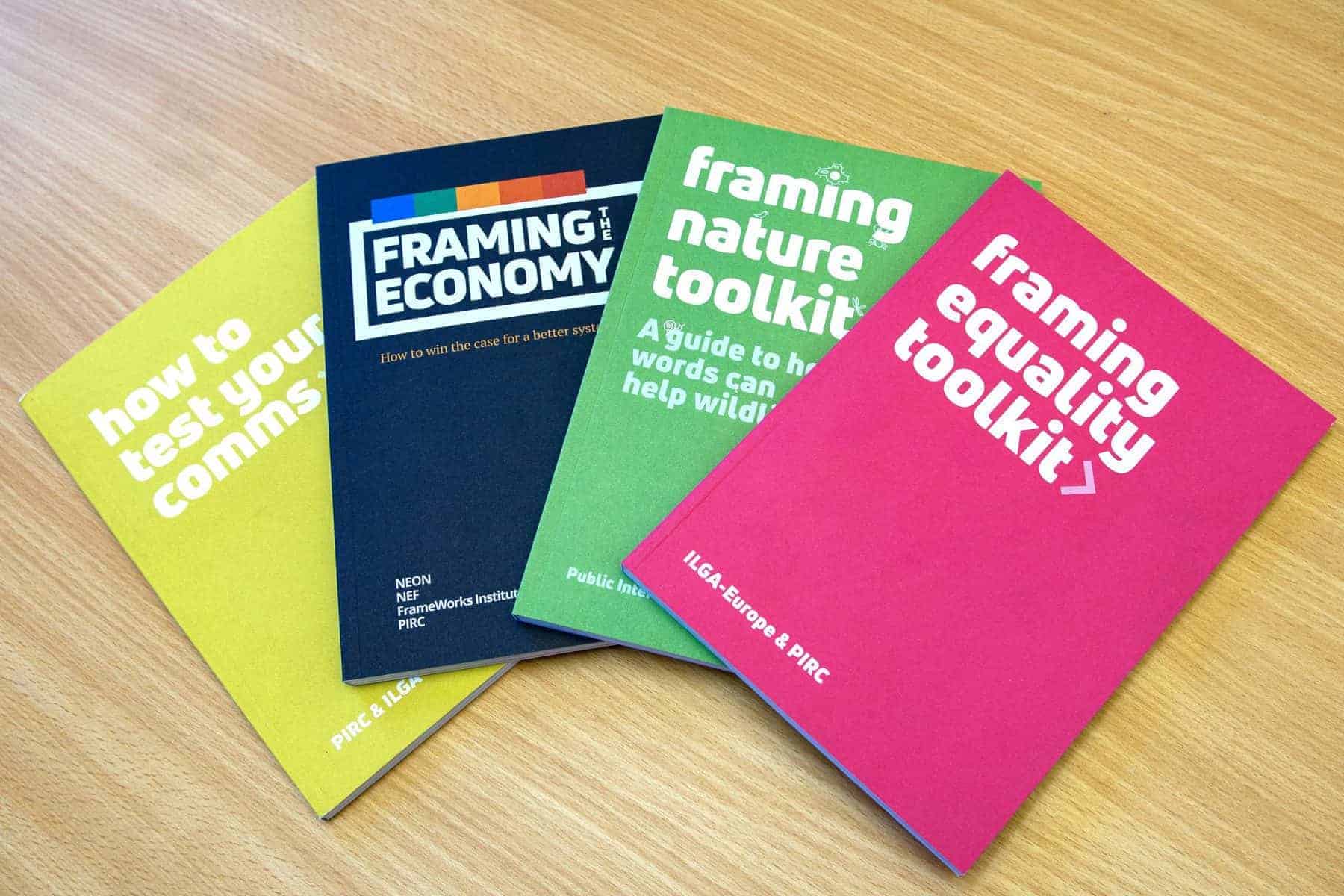
We recently met in London for our summer residential in the thick of the heatwave to reflect on our new not-quite-flat structure (more on this soon) with Kat Hobbs who supported our first steps towards unflattening last spring. We also undertook some work planning for the next six months which you can find out about below.
Eight Years on from Framing the Economy
Anu, our Head of Operations, penned a reflection on our Framing the Economy toolkit—on what we’ve learnt since, and where economic narratives sit today—after attending the ‘Shifting Cultural Perceptions of Our Economy’ conference, hosted by Friends Provident Foundation.
The basics of narrative change, framing and testing for progressive social change.
Working on communications and creative action when you’re trying to make change at the grassroots can often leave you feeling stretched. We’re rapid-responding, reacting to the latest news story, campaign setback, or key moment. And we don’t get the support we need to work out how our efforts sit in the wider landscape of social change, or how our ideas will play out further down the line, affecting the way people think, feel and act in the longer term.
So, here’s an offering from us, to give you some space to learn and to get creative with new ways of approaching our shared fights for justice—we’re launching our brand new free mini-series of introductory online workshops.
It’s been eight years since we published Framing the Economy. Back then, one participant told us:
“I think the economy is set by men in suits basically, and they will always profit from it, and profit enormously.”
This quote summarised what we heard consistently — people felt the system is rigged and they didn’t believe it could change. We published the report in 2018 to try and shift that sense of fatalism. Over the last two years, FrameWorks UK, our original partner on the mindsets side of this work, went back to see how public thinking about wealth and the economy has shifted since then.
First, some big internal news — after ten years as a flat structure organisation, we’ve unflattened (just a little). We hope to put our reflections in writing soon; watch this space!
You’ll likely know Hannah, previously our Curriculum Lead extraordinaire, who returned from parental leave as our new Head of Programmes alongside a new team member, Anu, as Head of Operations. We’ve been getting to know each other as a team with Ant and Faith, and had two lovely residentials in beautiful Machynlleth.
The Public Interest Research Centre (PIRC) is seeking new trustees. We are particularly interested in folks with experience of fundraising, and of narrative/framing work.
Building Our Narrative PowerThe final residentialPeer-learning and community dreaming on a narrative change residential
We ate delicious food, watched Twilight and experimented with new learning styles, in a collective journey towards better UK-based narrative change infrastructure.
How can we build communities of learning, growth and care, focused on narrative change? This is the question we set out to ask at the start of Building Our Narrative Power (BONP) – our year-long narrative leadership programme. We’ve been led by 14 participants and a bunch of amazing facilitators, and we’re about to draw to a close. But before we share reflections on the whole programme, I’d love to tell you a bit about our second, and final, residential, that happened in November 2024.
So, let’s set the scene. We are in the beautiful countryside, the weather is as British as ever, fourteen change-makers from across the UK show up keen to reconnect and learn…
Content warning: this piece contains mentions of racism, Islamophobia, Nazism and genocide
The recent wave of far-right extremism in the UK—manifesting as violent riots targeting mosques, places of refuge, Muslims, and people of colour—has been deeply troubling to watch. But for many, ourselves included, the events are unsurprising. These racist attacks resulted from years of divisive narratives pushed by the media and politicians, and repeated excessively throughout UK society.
Building Our Narrative PowerHalf way there!Reflections from the first half of our narrative leadership programme
It’s been five months since we officially launched Building Our Narrative Power (BONP) and began working with our cohort of 14 community organisers, campaigners, and activists.
January
We hosted our first residential in January, nurturing a space to build trust, community, and to strengthen group dynamics. Together, we celebrated a shared sense of leadership, renewal and building connections and bridges between our issues and work. In laying these initial foundations, participants opened up and engaged in honest, meaningful discussions, while beginning to take ownership of crucial aspects of the programme – including leading their own sessions. It was a joy to see the non-hierarchical and co-created approach that we envisioned underpinning this journey, being reflected so early on.
Since then, a strong spirit of community has continued to flourish. Following the residential, participants set up their own ‘Community of Practice’ calls between BONP sessions, sharing tools, resources, and opportunities with each other. They’ve organised their own in-person meetups and peer-to-peer learning. Through this self-contained space, they’ve created a shared “narrative north star” to guide them through the year.
…you could really tell how invaluable being part of a group was. I think bringing isolated campaigners to the space was a good idea.” – Facilitator
Building Our Narrative PowerFourteen change-makersReflections from the first residential of our narrative leadership programme
Since launching Building Our Narrative Power last summer, we have had the incredible opportunity of working with 14 community organisers, campaigners and activists. The folks we’re working with come from a variety of different backgrounds and social justice struggles. We have been working together to shape the programme, bringing in their ideas, skills and experiences to co-design a year of learning and leadership development.
On a Wednesday afternoon, just before logging off, I received an email: “Save the date for a global convening on narrative change that IRIS, Puentes and Global Narrative Hive are co-organising this October in Bogotá.” A work trip to Colombia? Yes please! The opportunity to learn about narrative change outside of the UK and to learn from global narrative change practitioners felt too good to be true!
The first day of the conference arrived, and I felt the awkwardness and excitement of a first date. I was not sure who to approach, where to sit, or what to do with my hands. Then the facilitators welcomed us to the space and I began to relax. Matthew Armstead led us in the diversity welcome. I felt welcome as they named aspects of my identity: bisexual, survivor, in my 20s, feeling nervous, religious background.
Who is allowed to know things in our society? Duwayne Brooks wasn’t. When Duwayne’s friend, Stephen Lawrence, was murdered in a racist attack in south-east London in 1993, he told the police what he’d seen: six white thugs killing his friend while shouting racist abuse. But his testimony was discounted because, as a young Black man, Brooks was not considered a credible witness by the Metropolitan police.
The political philosopher Miranda Fricker describes Brooks’ experience at the hands of the state as ‘testimonial injustice’ – an injustice perpetrated when someone’s account is rejected because of prejudices about their characteristics. Systemic oppression makes you unbelievable, no matter what you saw, no matter what you say. Examples abound: consider sex workers who are told they can’t have been raped because they’re sex workers; women who urge doctors to believe their physical pain, only to be told it’s in their heads; children whose disclosures of abuse are smoothed over for the sake of adult peace; trans people whose gender identities are derided… the list goes on.
This is, for Fricker, part of an overarching problem which she calls ‘epistemic injustice’, and which I’m introducing here as one portal (of many) into understanding why we need to ensure narrative change is led by those currently excluded from that work. Episteme means knowledge, so ‘epistemic injustice’ is a way of conceptualising the many oppressions perpetrated in the realm of knowledge. Who gets recognised as knowing things? Which knowledge counts? How must knowledge be packaged and communicated to be credible? I’m sure we can all think of many encounters with gatekeepers of these capacities, both our own and those we’ve witnessed.
When I started thinking about what to write I had been cat sitting for my best friend who has a pretty decked out kitchen – and I was planning to make the most of all the fancy appliances. While that did not happen, I instead was left with the feeling of being nourished. I ate well, spent time in nature, I moved my body and finally did some reading of a book I’m excited to borrow once my best friend is done with it.
When we think of learning, we often think of schools, colleges, universities. But learning is an ancient thing, that existed before all of these institutions and will exist long after. Its something that crosses species: like how honeybees dance to teach others where to find the best flowers. Every species on earth is what it is today because it learnt from the generations that came before.
Are you a changemaker, a storyteller, or someone who’s looking to shift the way people think, feel, and act? Then we’d love to learn, grow, and build collective narrative power with you.
APPLICATIONS ARE NOW CLOSED. Thanks to everyone who has applied, we’ll be in touch soon. If you’re interested in supporting the programme as a mentor, trainer, or content partner, email our Workshops Lead, , with a bit of info about you, how you’d like to be involved and any useful links 🙂
We’re excited to launch the ‘Building Our Narrative Power’ course—supporting people who have lived experience of the issues they are fighting for, to skill-up and shape the narrative for justice and social change, to create waves of action and lasting progress. We’re looking for 16 people who are all passionate about transforming societal narratives across social, climate, and economic justice.